
Hercules City Directory Collections on the Shelf
The strongest Hercules city directory lead is a regional shelf at the Richmond Museum of History & Culture, supported by the Contra Costa History Center, Hercules Library, Pinole Library, and countywide digital databases. The table keeps the collection boundary visible. “West Contra Costa” or “countywide” does not guarantee a Hercules entry, so confirm the locality and reverse section in the volume itself.
| Collection | Years | Where held | Access |
|---|---|---|---|
| West Contra Costa city and telephone directories | 1903-2015/16, selected issues | Richmond Museum research room | On-site Thursday-Sunday, 1:00-4:00; appointment and Hercules verification |
| County assessor books | 1850-1910 | Contra Costa History Center | On-site or paid staff research; property-owner bridge |
| Historical courts and probate | 1850s through mid-20th century | History Center and Superior Court | Physical indexes, online probate index, or court records route |
| Pinole Hercules News and clippings | February-December 1946; clippings 1899-1970 | Pinole Library | Microfilm and local-history access |
| Federal census and local-history databases | 1790-1950 extant schedules | NARA, Hercules Library, HeritageQuest, Ancestry Library | 72-year release rule; Ancestry in-library only |
That mix makes a Hercules city directory search a routing exercise. The Richmond Museum owns the most clearly documented run, the History Center supplies property and family context, and the library offers electronic tools. The exact Hercules page still must be checked in the named volume.
Which Directory Years May Include Hercules?
The finding guide names publishers and territories rather than promising a continuous Hercules run. Pacific States Telephone & Telegraph has an Alameda and Contra Costa County volume for 1903. Richmond Directory Publishing covers 1907 and 1908, and Northwestern Pacific Railroad has Richmond volumes for 1909-10. R.L. Polk issues for Richmond, Martinez, and named territories include 1910-11, 1911-12, 1912-13, 1914-15, 1915-16, 1916-17, and 1918. Richmond Daily Leader is listed for 1911.
| Period | Documented shelf detail |
|---|---|
| 1903-1910 | Countywide Pacific Telephone, Richmond Directory Publishing, and Northwestern Pacific Railroad issues. |
| 1910-1921 | Polk Richmond/Martinez territories, Richmond Daily Leader, and Western Directory Richmond/Pullman/Stege or wider named territories. |
| 1921-1965 | Selected Polk issues, including 1921, 1922-23, 1923, 1925-30, 1932, 1934, 1937, 1939-40, 1942, 1947-48, 1950, 1953, 1954-58, 1960-61, and 1962-65. |
| 1949-2015/16 | Later Pacific Telephone, Pacific Bell, AT&T, Valley, and Real Yellow Pages issues, with selected west-county years. |
The shelf's publisher changes are easier to remember as a short record-keeping timeline:
- 1903: Pacific States Telephone & Telegraph supplies the earliest documented Alameda and Contra Costa County volume.
- 1907-1911: Richmond Directory Publishing, Northwestern Pacific Railroad, R.L. Polk, and Richmond Daily Leader issues widen the regional mix.
- 1920-1965: Western Directory and later Polk issues continue selected Richmond, Pullman, Stege, San Pablo, El Cerrito, and wider territory runs.
- 1949-2015/16: Pacific Telephone, Pacific Bell, AT&T, Valley, and Real Yellow Pages extend selected west-county access.
Countywide Pacific Telephone issues are listed for 1913, 1914, 1925, 1934, 1935, 1940, 1941, 1943, 1945, and 1947. Later Pacific Telephone or Pacific Bell west Contra Costa books include 1949, 1955, 1961-65, 1967-70, 1972, 1974-85, 1987, 1992-97, and 2001-02. Selected AT&T, Valley, and Real Yellow Pages continue through 2015-16.
Those dates describe holdings, not verified Hercules inclusion. The best first question for the Richmond Museum is whether a particular countywide or west-county volume has a Hercules locality, street section, or address-order half.
Read a Hercules Directory Entry
A city directory entry is compact and coded. Before copying a name, note the title page, publisher, year, territory, page number, and abbreviation key. The inventory below describes fields worth checking in a real volume. It is not an inspected Hercules entry, because no actual local sample or authoritative Hercules-specific reverse run was viewable online.
| Name | Surname and given name, with a spouse or household relation sometimes printed in parentheses. |
|---|---|
| Occupation | A historical occupation or affiliation when the publisher included it; preserve the wording without treating it as a present fact. |
| Address | House number and street, sometimes paired with a business address or a short residence mark. |
| Household mark | An owner, widow, boarder, or other notation if that publisher used a symbol or abbreviation. |
| Year and page | The observation date and page needed to compare the same name across nearby issues. |
- Criss-cross section
- An address-order portion of a directory, usually read by street and number instead of surname. Hercules inclusion must be verified in each volume.
- Householder index
- A name or household reference that helps a researcher move from a street entry to an alphabetical listing, when the volume provides one.
- Abbreviation key
- The publisher's explanation of short marks for occupations, relationships, residence, or status. Find it before interpreting a line.
Do not expand a mark from memory. A disappearing surname can mean a move, death, missed subscription, a changed spelling, or a territory boundary. Compare at least one adjacent issue and one independent record.
Richmond Museum Holds Hercules City Directories
The Richmond Museum of History & Culture research room is the best documented place to inspect the printed city directory collections. The museum says its directories can reveal dwellings, businesses, occupation, ownership, and local context. Research room hours are Thursday through Sunday from 1:00 to 4:00 p.m.; an appointment is recommended at (510) 235-7387. Museum staff do not perform patron research, so bring a precise year, surname, address, and question and inspect the volume on site.
The museum also holds yearbooks reaching back to 1909. That companion shelf can help reconnect classmates or place a household in a school-era setting, but it is not a substitute for a directory or census. Ask whether a volume contains a street section and whether its abbreviation key survives before spending time on every name page.
The branch and research room image comes from the Hercules Library location information, which is a useful first stop for reference routing before visiting the regional shelf.
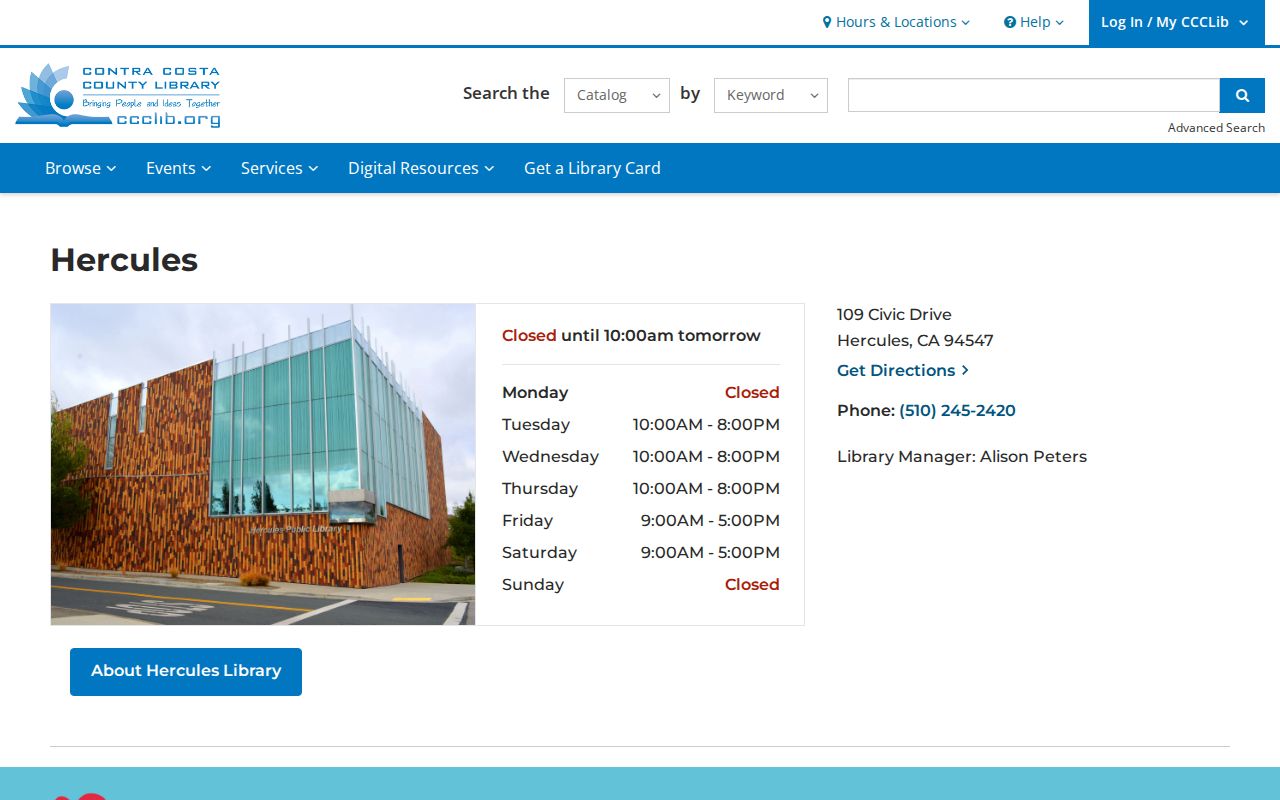
The image points to local access rather than a claim that the Hercules branch owns every Richmond volume. Ask the branch to distinguish its own shelves from countywide electronic access and to suggest a reference or interlibrary route.
Hercules City Directory Digital History
Hercules Library is at 109 Civic Drive, (510) 245-2420, and is open Tuesday through Thursday from 10:00 a.m. to 8:00 p.m. and Friday through Saturday from 9:00 a.m. to 5:00 p.m. Ancestry Library Edition is available inside a library and does not require a card at the branch. HeritageQuest supplies every extant United States census from 1790 through 1950, plus family and local-history books, Revolutionary War pensions, Freedman's Bank, and PERSI. Local History Connection is available through the county digital collection.
The Contra Costa digital local history collection is useful for photographs, newspapers, maps, and local context. It should be treated as a companion to the physical directory shelf, not as proof that a particular Hercules city directory has been digitized. The collection image below shows the digital-history route.
Keep the search terms separate: exact surname, address, organization, and year. Old type and optical character recognition can mishandle initials and street names. A librarian can help route a question without turning a general database into a complete resident roll.
Hercules Directory Indexes at the History Center
The Contra Costa County Historical Society and History Center is at 724 Escobar Street, Martinez, (925) 229-1042. Hours are Tuesday through Thursday from 9:00 a.m. to 4:00 p.m., plus the first and third Saturday from 10:00 a.m. to 2:00 p.m. Its holdings include 9,300 or more indexed historic court files naming more than 61,000 people, 1,000 or more probate items, 13,000 or more naturalization records, 4,000 or more obituaries, 26,000 or more West County Times items, and 1,700 or more map records.
Hercules clipping folders are organized under City Services, History, Business, People, and Real Estate. PACT provides free on-site access to digitized photographs, nineteenth-century newspapers, maps, and county histories. The initial staff review is free; personal research is $20 per hour for members and $30 per hour for nonmembers. Ask for an exact full name or variant, known Hercules or west-county place, year range, and desired collection.
The History Center collections page is the source for the archive and reading-room route.
History Center indexes can close a gap when a city directory only gives a surname and address. Probate, obituary, naturalization, tax, map, and court clues still need identity checks across dates and places.
Newspapers Fill Hercules Directory Gaps
The Pinole Hercules News has February through December 1946 microfilm at the Pinole Library, and Pinole historical clippings cover 1899-1970. The History Center also holds the Contra Costa Gazette for 1864-1901 and later county titles, searchable at two PACT terminals or on microfilm. These windows can supply a move, obituary, sale, civic appointment, or community reference when a directory skips a year.
The Contra Costa history databases list searchable probate, obituary, newspaper, map, and related resources. Search an address, surname, and company or organization term separately. Newspaper OCR often mishandles initials and old type, so inspect the original film or image when a result matters.
The Contra Costa history database collection image below represents a research index, not a named Hercules directory page.
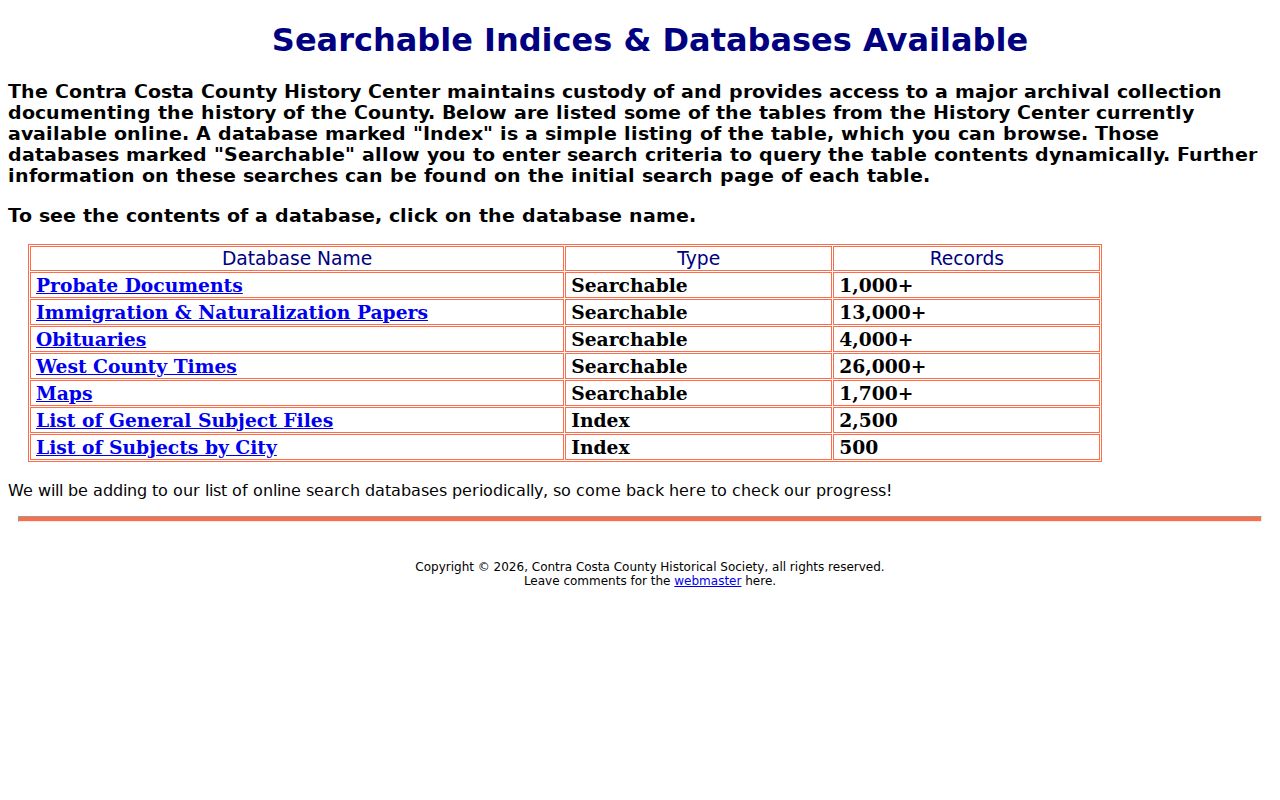
Use a newspaper mention to generate a date and spelling, then return to the directory shelf or census. A brief notice can corroborate a household without proving that every person mentioned lived at the listed address.
Hercules Company-Town Context Matters
Earlier Hercules city directory research sits inside a distinctive local record history. The plant opened in 1881, the town incorporated on December 15, 1900, and early council records were closely connected to plant managers. Hercules Powder followed the 1912 DuPont breakup. Explosives ended in 1964, the fertilizer and company phase ended in the late 1970s, Centex acquired buffer land in 1974, and subdivisions began in 1975 before the large growth of the 1980s.
That shift helps explain why a household may appear under a regional company or plant context rather than a modern subdivision label. It also makes the History Center's tax books, maps, newspapers, and industrial photographs useful companions to a directory. The local story adds context, but it does not turn a regional directory into a verified Hercules roster.
A 1908 powder-works blast killed 24 people, and 59 people died in the first 38 years of plant operation. Those figures belong to local history, not to an inference about any directory entry. Keep historical facts and personal identity evidence in separate notes.
Trace Family History through Hercules City Directories
Use a Hercules city directory as a dated thread between stronger records. Start with the closest known surname, place, or year, then work outward through adjacent issues. The goal is a reproducible trail with a page citation, not a single attractive match.
- Choose the nearest issue. Confirm publisher, territory, year, page, and the presence of Hercules before copying a name.
- Follow the line. Compare nearby years for spelling, address changes, spouse or household marks, and a move between regional sections.
- Check the address order. If a criss-cross section exists, read it as a separate evidence layer and preserve its abbreviation key.
- Pair the census. Match 1900 through 1950 observations with the nearest released census. The 72-year rule limits later census access.
- Close the gap. Use newspapers, obituary or probate indexes, maps, and naturalization material to test identity and explain a disappearance.
A household can vanish from a city directory because it moved, died, changed spelling, stopped subscribing, or fell outside a publisher's territory. Pairing a city directory with a census makes those possibilities visible. When the question turns to current parcel ownership, use the Hercules street address records instead of forcing a historical directory to answer a modern property question.