
Hercules Sources for an Address History
A house-history search in Hercules changes sources as it moves back through time. RecorderWorks carries the strongest modern deed index. The Old Book path bridges earlier instruments. The History Center holds older tax and court material. Directory issues and census schedules capture households at dated moments. Permits show physical work on a parcel. The coverage table below keeps ownership, occupancy, and physical-change evidence in separate lanes. That separation is exactly how a clean address history should read.
| Source | Years it covers | Where held | What it shows |
|---|---|---|---|
| RecorderWorks | 01/01/1986-present; deed APN search 03/03/1997-present | Contra Costa Clerk-Recorder online index | Named instruments, parties, dates, numbers, and legal descriptions |
| Old Book, fiche, and counter | Pre-1986; earliest online Old Book year unstated | Recorder workflow and office terminals | Grantor, grantee, book, page, and earlier instrument bridge |
| Assessor books | 1850-1910 | Contra Costa History Center | Annual property-owner and description clues |
| Telephone and city directories | Selected countywide 1903-47; west county through 2015/16 | Richmond Museum research room | Subscriber or occupant clue; Hercules inclusion must be checked |
| Federal census | Public through 1950 | NARA, HeritageQuest, and Ancestry Library | Household at an enumeration address and date |
| Permits and city records | County ePermits 01/01/1980-present only with county jurisdiction | County DCD, Hercules Building, or City Clerk CPRA | Applications and physical work, not a complete occupancy record |
Pick your starting record by era. A recent ownership chain begins with the present parcel. Company-town questions start at the History Center, the Richmond Museum, or the newspaper shelf. For a later household, pair the nearest directory issue with the nearest released census, then test the name against an obituary or a probate record.
Start with Hercules Parcel Identity
Start with the land, not the name. Type the current situs address into Contra Costa ParcelQuest Lite or CCMAP and write down the APN. Note the parcel boundary, building and lot facts, the aerial view, contours, and the assessor map link. Both county map tools accept a street address or an APN. CCMAP will even select a radius. Neither one displays owner names online. That is fine. The parcel is the fixed land reference, and it keeps a house-history search intact when a mailing label changes or a lot splits.
Next, carry the APN to the Assessor counter at 2530 Arnold Drive, Suite 100, in Martinez. It is open Monday through Friday from 8:00 a.m. to 4:00 p.m. You can also call (925) 313-7400. Prices are posted plainly. Expect $1 per page for a printout, $7.50 per parcel for characteristics, $3 for a map plus $2.50 for mailing, and $50 for staff radius research. Ask for the roll owner and the last tax mailing address. Label that mailing address carefully, because it is not proof the owner ever occupied the Hercules situs.
The Contra Costa tax lookup rounds this out with secured bill status and history. Search it by address or APN. Keep tax evidence, assessor ownership, and true household evidence in separate columns of a research log.
Follow a Hercules Deed Chain Backward
A deed chain starts with the current roll owner, but recorded instruments prove it. Search that owner in RecorderWorks and locate the title-transfer deed. Read the legal description and identify the seller. Search the seller next as an earlier grantee. Every turn takes you one transaction deeper. Record spelling variants, instrument number, recording date, book or page, document type, and APN whenever the index supplies them.
- Fix the parcel. Confirm the current situs, APN, map shape, and legal description in the county property tools.
- Get the roll owner. Use the Assessor counter because the online parcel display suppresses names. Save the tax mailing address as a separate field.
- Find the purchase deed. Search the owner in RecorderWorks and narrow by date and deed, grant deed, or quitclaim type. An APN search works for deeds recorded from 03/03/1997 forward.
- Reverse the parties. Treat the seller, or grantor, as the next earlier grantee and repeat the search. Compare the legal description at each link.
- Bridge the cutoff. Use Book and Page for identified 1986-1993 material, then move to Old Book, index, fiche, or counter access before 1986.
- Grantor
- The party who conveys an interest in the recorded instrument, often the seller in a deed.
- Grantee
- The party receiving that interest, often the buyer in a deed.
- Chain of title
- The linked sequence of recorded transfers that connects a current interest to earlier parties.
- Legal description
- The formal land description used in the instrument. It can identify the parcel when a street address or APN changes.
RecorderWorks Cutoffs Shape the Hercules Trail
RecorderWorks has a firm modern boundary. Named searches cover 01/01/1986 to the present, while deed APN searches begin 03/03/1997. The interface also offers document number, document type, map date and type, Book and Page, and Old Book paths. A name search takes last-name-first format. It also takes a name-combination selector, a date pair, and an “Allow Partial Match” option. Start with a tight date window and title-transfer types before widening to liens or financing records.
The RecorderWorks official-record index is free to search. The site posts no current image or copy price. Results go into a cart. A name result can lead to associated documents by type and date. Remember that a deed of trust or a reconveyance usually documents financing. It is not a change in who lived at the property.
Before 1986, the Old Book sequence runs Display Index. Then it runs Display Fiche Cell. Then search or display the document. For 1986 through 1993, Book and Page can bridge the gap. If the title chain stalls, never plug the hole with a guessed street number. Move to the legal description, the map archive, the assessor book, or the counter route instead.
Hercules Maps Preserve Parcel Continuity
A past-resident trail that appears to jump streets often has a mapping explanation. The Contra Costa Public Works map archive holds subdivision and minor-subdivision maps, surveys, and corner records. It also keeps annotated assessor books and superseded pages. Two address strings may describe the same land. Compare the lot and block before concluding otherwise. Then check the legal description, any former APN, and the neighboring parcels.
The archive has limits worth knowing. No authoritative Hercules Sanborn sheet or year is established. The county documents no verified street-renumbering project. An old number that refuses to match belongs in front of the map archive, the assessor book, and the deed description. The local history shelf belongs there too. Skip the invented renumbering theory.
Hercules itself grew in layers, from a powder-company village on the waterfront into mid-1970s and 1980s subdivisions. Later came villages like Victoria by the Bay, Promenade, Bayside, and Baywood. A development-era clue points toward the next record set. It never replaces the parcel identity.
Hercules Household Clues Across Old Records
Property owners are just one strand of the story. Old city and telephone directories can name a subscriber or occupant. A census fixes a household at a single enumeration date. The Richmond Museum shelf is regional and selected. Its issues run from 1903 through 2015/16. No authoritative Hercules-specific directory or reverse run was cataloged, though. Confirm the territory covered first. Check that a Hercules section actually appears before trusting any page. The Hercules city directory collections page lays out the publishers. It also lists the years and the access routes. Once the parcel and date are settled, apply the household process described below.
- Choose a dated issue. Start with the nearest countywide or west-county directory, copy the entry exactly, and cite its page and publisher.
- Compare adjacent issues. Note spelling, spouse or household marks, address changes, and whether an address-order section exists.
- Pair the census. Match the directory observation to the nearest released census from 1900 through 1950 and record the enumeration district and household.
- Test the gap. Search Pinole Hercules News microfilm for February-December 1946, Pinole clippings for 1899-1970, and later West County newspaper material.
- Close with identity evidence. Use an obituary, probate item, naturalization record, or map only when names, dates, and places agree.
A line that vanishes can signal many things. A move, a death, a spelling shift, non-subscription, or a territory boundary shift could all explain it. Label each clue honestly. Past residents belong in one of three buckets: documented household clue, possible match, or title party. Never blend them.
Hercules Permits Date Work, Not Residents
Permits tell you when work happened, not who lived there. Contra Costa County ePermits covers county permit and planning history from 01/01/1980 forward, and only where the county held jurisdiction. An incorporated Hercules address may therefore sit in city-held files instead. The Hercules Building Department and Permit Services office is at 111 Civic Drive, (510) 799-8244, open Monday through Thursday from 8:00 a.m. to 1:00 p.m.; the 1:00 to 5:00 p.m. window is by appointment, and the office closes Friday.
City records run through the City Clerk's CPRA route, also at 111 Civic Drive. Call the clerk at (510) 799-8208 or the general line at (510) 799-8200; City Hall keeps Monday through Thursday hours, 8:00 a.m. to 5:00 p.m. The request form accepts mail or email, carries a ten-day determination period, and charges $0.25 per printed page. Ask for existing address files, permit history, or dated correspondence, not an answer about who lived there.
Applicant and contractor names on permits can date a change to the property. They do not identify the owner or a past household on their own. Expect copyright or security limits on plans, even when basic file metadata is open.
Hercules Obituaries and Probate Close the Trail
A prior owner or household member may have died. Obituaries and probate records put the deed and directory trail to the test. The Contra Costa History Center sits at 724 Escobar Street in Martinez, reachable at (925) 229-1042, open Tuesday through Thursday from 9:00 a.m. to 4:00 p.m. plus the first and third Saturday from 10:00 a.m. to 2:00 p.m. Its indexes run deep: more than 4,000 obituaries, more than 1,000 probate items, and more than 9,300 historic court files naming more than 61,000 people. PACT is free on site. Initial review is free. Personal research runs $20 per hour for members or $30 for nonmembers.
Modern probate stays with Contra Costa Superior Court. The court's civil and probate information page notes that online probate access may show a register of actions. Documents require the Records route. Search with the decedent's full name, place, and date, and respect restricted petitions and redactions.
Note: The court's civil and probate access route is a records channel, not a household directory.
A probate petition or notice can identify interested people and their addresses. Even so, the record must still agree with the parcel, the date, and the family evidence. A shared surname alone is never enough.
Hercules Criminal Files Take a Separate Route
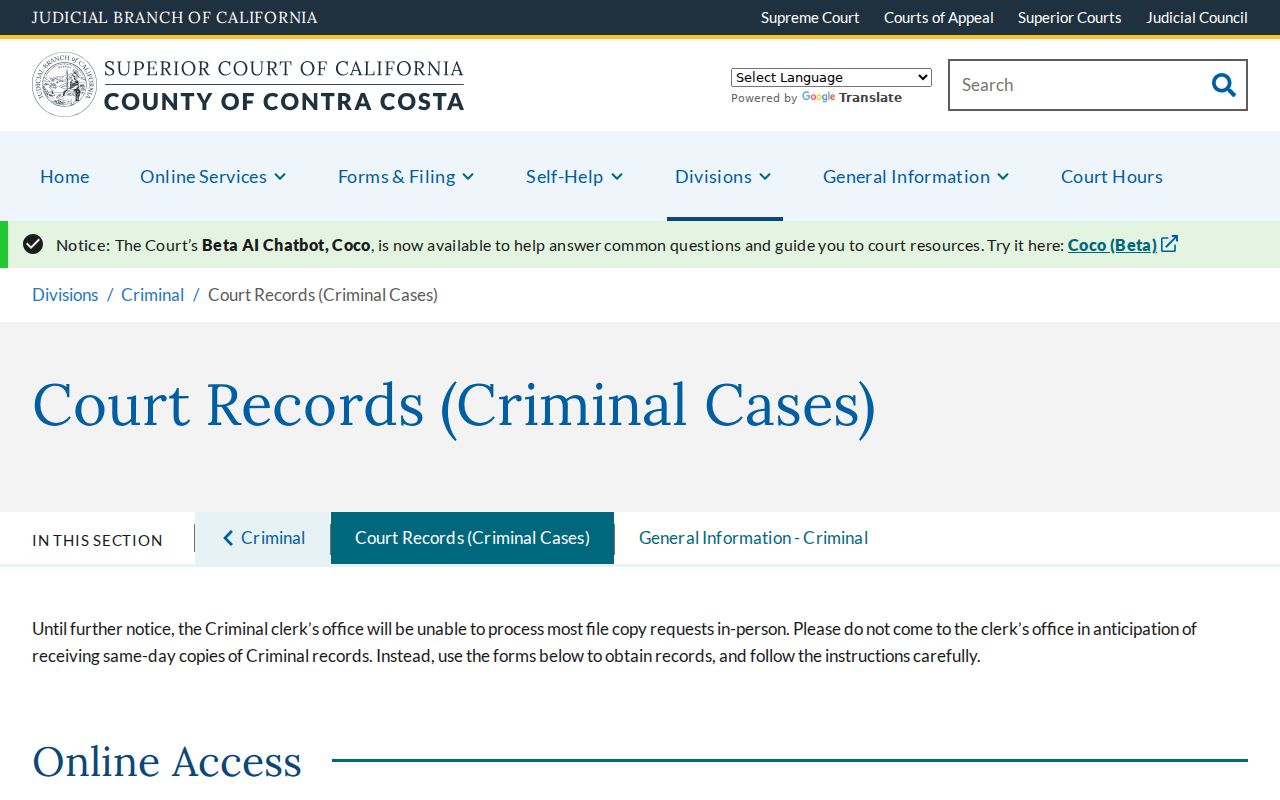
A court-name result is not an identity match. It is not a finding of wrongdoing either. Criminal records follow a separate request path. The Contra Costa Criminal Records Unit uses CR-147 for a name search and CR-114 for copies or credit-card requests. Filing routes include Richmond, Pittsburg, or Martinez. The court cautions that same-day counter copies should not be expected. Copies run $0.50 per page.
The Contra Costa criminal court records page is the source for that access channel. Before treating a result as a historical clue, record the exact party role, case number, filing date, location, and case type. Sealed, confidential, juvenile, and other restricted records may not appear online or be released by phone.
Note: the criminal-records page shows the request route and is not a sample Hercules case.
For an ambiguous name, stop at "possible match." Move past that label only when an independent deed, address, date, license, obituary, or family record resolves it. Court party status alone does not prove residence at the Hercules address.
Limits of a Hercules Past-Resident Trail
Every record type has a ceiling. A deed proves a recorded transfer, not that the grantee lived on the parcel. An assessor mailing address shows where tax correspondence went, not who occupied the situs. A directory can omit non-subscribers. A census captures one date. A permit dates work, but an obituary or probate file marks a life event. That event may have occurred after the person left.
California Safe at Home can create a substitute mailing address for qualifying protected people. It can also provide confidential voter registration. A missing address may therefore be intentional. Accurate public deeds and recorded maps survive any commercial deletion request. No lawful research method turns restricted fields into a complete list of living household members.
Lawful house history. Use previous-resident records for personal genealogy, parcel history, and family research. Do not use a past address trail to stalk, harass, intimidate, or publish identifying details to cause unwanted contact. When the evidence stops at a historical clue, leave it there.